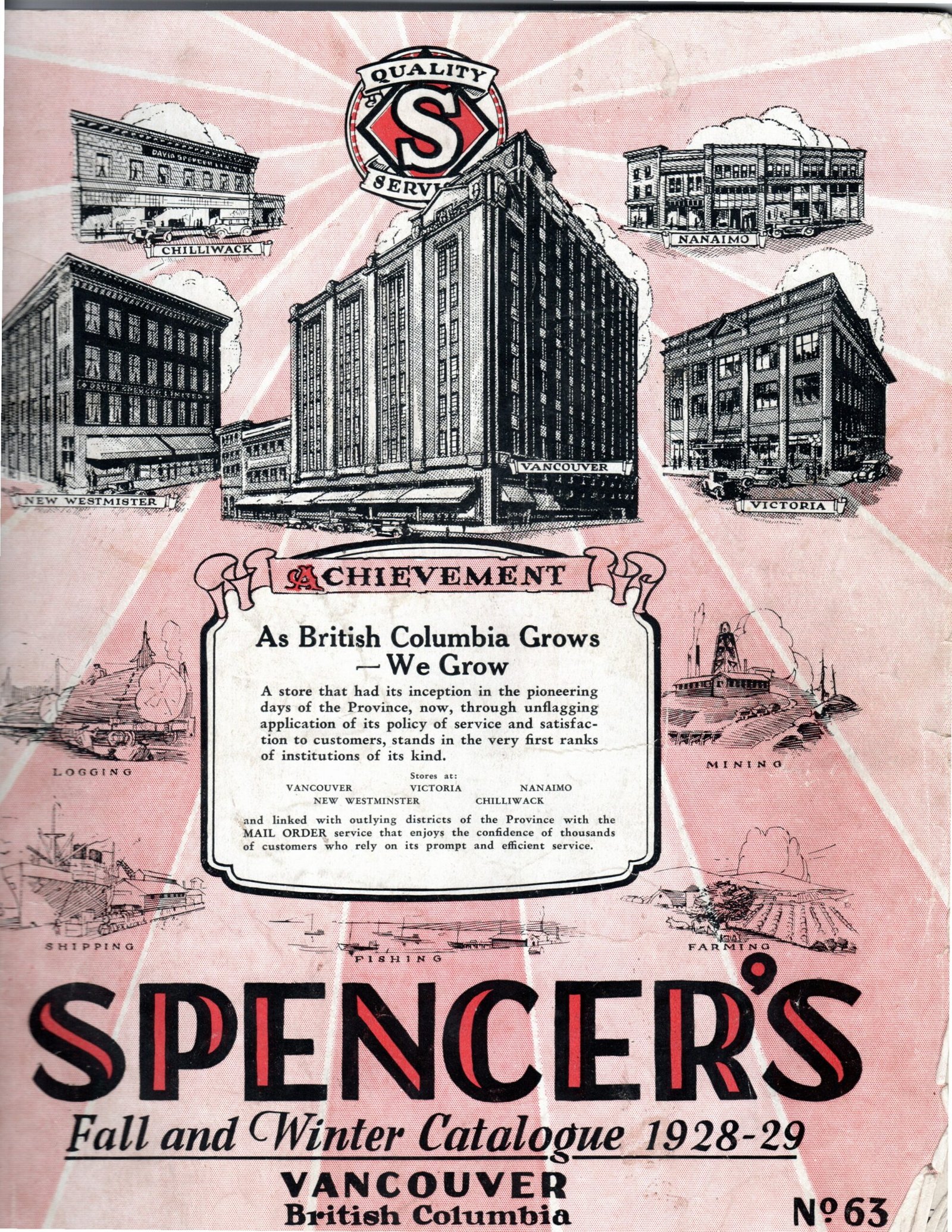


Spencer’s mail order catalogues, a subsidiary of David Spencer Limited, aimed to bring affordable fashion, extensive household goods, and myriad services to those residing outside of Vancouver and Victoria. Although its focus was British Columbia, Spencer’s reach extended beyond the province, including to those stationed overseas during World War II.
In its quest to be the “mail order house of the west,” Spencer’s acknowledges and responds to an ever-evolving society. During the mid-1930s to mid-1940s, women’s hemlines leap from mid-calf to just below the knee. Tops now include masculine-tailored Tooke Shirts alongside more feminine frilled blouses.
It is in menswear, though, where the catalogues most reflect changing times due to World War II, as military apparel, footwear, and insignia take precedence over workwear and casual dress. The reality of war infiltrates beyond men’s fashions.
Throughout its catalogue pages, Spencer’s implores shoppers to purchase war savings certificates while dissuading hoarding and “lavish spending.” Customers are forewarned of shortages and reminded to indicate their second and third choices upon ordering to avoid disappointment. Life goes on for those far from the front lines and Spencer’s responds accordingly.
In addition to fashion for all ages and goods ranging from auto supplies to zippers, Spencer’s offers its customers eclectic services such as tanning raw fur and engraving initials on handbags in 18K gold leaf. Most striking to contemporary consumers, however, may be the familiarity and longevity of brand names featured throughout the catalogues. Alka Seltzer, Carhartt, Jantzen, Ovaltine, Penmans, and Westclox endure to this day—a rarity within the current environment of fast fashion and disposable goods.
This project is generously supported by the Irving K. Barber Learning Centre’s BC History Digitization Program.
The “Miracle Bras, Military Brass, Spencers: Catalogues, 1930s–1940s” collection presents a series of printed catalogues and related materials documenting foundation garments from the mid-20th century. The objects are primarily black-and-white catalogue pages, sometimes tinted or lightly coloured, featuring photographic and illustrated representations of undergarments.
The pages are arranged in a graphic, print-based format, combining images of garments with blocks of text, product descriptions, and numbering systems. Garments are typically shown on idealized female figures, posed upright and front-facing to clearly display construction and silhouette.
The collection focuses on foundation garments, including brassieres, girdles, corsets, and combination garments such as “Spencers” or “Spen-Alls.” These are depicted with attention to structure: visible seams, boning, straps, and fastenings are emphasized to communicate how the garments shape the body. Some images isolate individual garments, while others show full torso views to demonstrate fit and function.
Several catalogue pages include multiple variations of a single garment type, arranged in rows or grids. These highlight differences in length, support, and design features such as adjustable lacing, elastic panels, or integrated components. In some cases, diagrams or close-up illustrations draw attention to construction details.
The visual style reflects commercial presentation of the period:
In certain catalogues, a soft tint (often pink or warm-toned) is added to otherwise monochrome images, lending a sense of refinement while still maintaining a technical, product-focused appearance.
Across the collection, the garments illustrate the transition in undergarment design during the 1930s and 1940s, when structured corsetry coexisted with and gradually gave way to more flexible foundation garments. Items such as early brassieres and girdles reflect evolving materials and construction methods, including the introduction of elastic elements and new approaches to shaping the body.
Overall, the collection reads visually as a catalogue of function and form, where garments are presented not as fashion statements but as engineered objects—designed to support, shape, and structure the body beneath clothing.
This collection of printed catalogues presents foundation garments from the 1930s and 1940s, including bras, corsets, girdles, and combination undergarments such as Spencers. Produced in an era when undergarments were central to shaping the fashionable silhouette, the catalogues illustrate how the body was constructed beneath everyday dress.
Garments are shown on idealized figures and arranged in carefully structured layouts that emphasize clarity and comparison. Rows of bras, girdles, and supporting garments highlight variations in construction, fit, and function. Technical details—such as seams, boning, elastic panels, and fastening systems—are clearly visible, reflecting the engineered nature of these garments.
Across the 1930s and 1940s, foundation wear evolved alongside changing materials and approaches to body shaping. Corsetry continued alongside emerging bra-and-girdle systems designed for increased flexibility and comfort, while still maintaining a controlled silhouette.
The visual language of the catalogues is consistent: black-and-white photography and illustration, minimal backgrounds, and precise product labelling. Rather than focusing on fashion styling, the emphasis is on structure, support, and the relationship between garment and body.
Taken together, these catalogues offer a detailed record of how undergarments were designed, marketed, and understood as essential elements of everyday dress in the mid-20th century.
City of Vancouver Archives. Spencer’s Department Store Fonds. Vancouver, BC.
Records and visual materials documenting the operations, advertising, and retail presence of Spencer’s Department Store in Vancouver.
Places That Matter. Vancouver Heritage Foundation. “Spencer’s Department Store.”
https://placesthatmatter.ca/location/spencers-department-store/